Many patients spend years trying drugs without finding relief from depression. QEEG brain mapping provides a digital view of how your brain waves work. This data helps your care team create a unique plan that fits your needs.
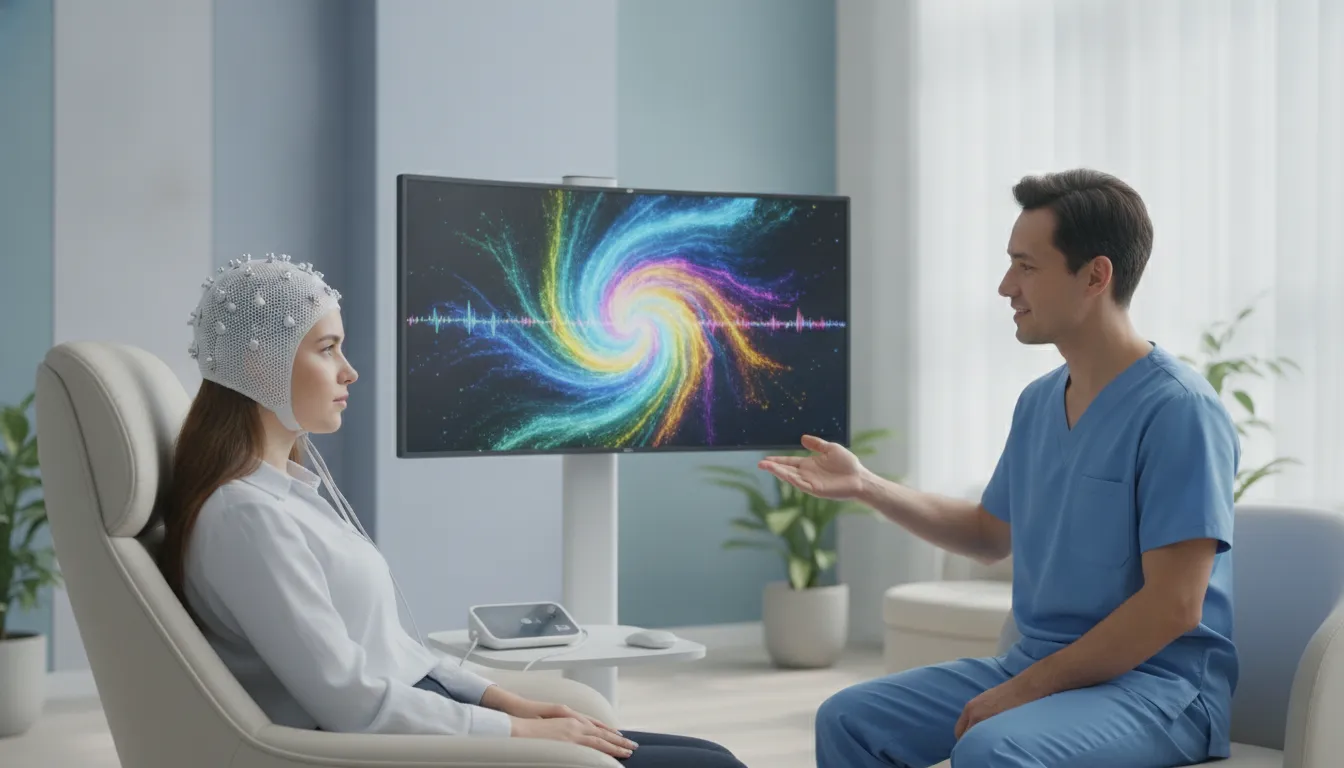
QEEG brain mapping is a non-invasive tool that records brain wave patterns to provide information about electrical activity across the brain. A clinician tracks these signals using a sensor cap while you sit in a calm room. Software then turns the data into visual maps. The maps can help a qualified clinician identify patterns that may add context to a broader mental health assessment. QEEG is one source of information, not a stand-alone diagnostic test or a guarantee that a particular treatment will work.
What is QEEG brain mapping?
QEEG brain mapping is a way to see how your brain works. It stands for quantitative electroencephalogram. This tool tracks the brain waves in your head. Most people know about standard EEG tests. Those tests show raw brain waves. But QEEG brain mapping goes further. It uses machines to turn waves into data. This helps doctors see which parts of your brain are most active.
The role of brain waves
Your brain uses power to send signals. These signals create patterns called brain waves. Some waves help you sleep. Others help you focus. A QEEG test records these patterns from many spots on your head. It looks at how fast and strong the waves are. This gives a full view of your brain health. It is like taking a photo of your brain’s work paths. This helps doctors see if your brain is in balance.
The process is safe and easy. You wear a soft cap with sensors on it. These sensors listen to your brain waves. They do not send any power into your body. This makes it a safe tool. It gives real facts about your mental health. This means the results do not rely on your feelings alone. Instead, they come from real data. This makes it a key part of modern mental health care.
Turning data into maps
Once the tracking is done, a machine reads the signals. It uses math to look at the data. This is what the “quantitative” part means. The machine compares your brain waves to a list of healthy brain patterns. This helps find areas where your brain might work too hard. It also shows where it might not work enough. The result is a color map of your brain. These maps show the power of your brain data. This helps your care team plan your care with ease.
Experts have used these maps for many years. They help study mood and fear. They also show how brain regions talk to each other. These are called brain links. A study in the National Institutes of Health database shows that QEEG gives deep insight. It lets doctors see things that a standard EEG might miss. This leads to a better plan for each person.
A tool for exact care
It is vital to know what QEEG mapping is not. It is not a way to diagnose a mental illness on its own. Clinicians interpret it alongside symptoms, medical history, interviews, and other appropriate assessments. It may add context to a care plan, but it cannot predict treatment response or remove uncertainty from treatment decisions.
Using this tool helps tailor your care. It shows how you might react to certain care plans. This is part of an exact care approach. It focuses on finding the right help for each person. By looking at your brain map, doctors can see your brain’s state. This allows for a more focused plan to help you. It gives you and your team a clear path to wellness.
What happens during a QEEG appointment?
A QEEG brain mapping visit is a simple and safe way to look at how your brain works. The process is noninvasive. This means we do not use needles or put any power into your body. Instead, we just listen to the small pulses your brain makes every second. This modern diagnostic test helps our team see patterns that standard tests might miss.
Getting ready for your scan
When you arrive, you will sit in a cozy chair. A trained staff member will help you get ready. First, they will clean small spots on your skin and earlobes with a mild gel. This helps the sensors get a clear signal. You should come to the visit with clean, dry hair. Do not use hair spray or oils on the day of your scan. These can block the sensors and make the data less clear. You do not need to do much during this time. Just stay relaxed and breathe as you often do.
Recording your brain waves
The main part of the visit involves wearing a special cap. This cap has small sensors that rest on your head. These sensors record your brain waves as data signals. We then use math to study these data. This helps us see how the parts of your brain talk to each other. Finding these patterns is a big part of how depression tests work in our clinic. The goal is to see exactly where your brain needs help.
- Setting up the cap. The staff puts the sensor cap on your head. They use a gel to help the sensors read your brain waves well.
- Eyes-open tracking. You will sit still for a few minutes with your eyes open. You may look at a point on the wall or a screen.
- Eyes-closed tracking. Next, you will close your eyes for a few more minutes. This lets us see how your brain waves change when you rest.
- Checking the data. The staff looks at the data right away. They look for “noise” from eye blinks or small muscle movements.
- Cleaning the data. We fix the data to make sure it only shows your brain’s work. This ensures the final map is right and useful.
- Final review. We compare your brain paths to a set of healthy brains. This shows where your brain may be too active or too slow.
- Doctor check. Your doctor looks at the final report. They will meet with you later to go over the results and talk about your care plan.
What to expect after the visit
Appointment length and preparation instructions vary by provider. You may have a little gel in your hair afterward, which can usually be washed out at home. Because the sensors record rather than stimulate brain activity, the recording itself is noninvasive. Ask your provider what to expect before and after your specific appointment. Your clinician can explain whether the results add useful context to your broader care plan.

What can a QEEG brain map show?
QEEG brain mapping is a high-tech tool that shows how your brain works in real time. It records electrical activity to find patterns that a standard check might miss. This tool does not give a simple diagnosis by itself. Instead, it gives doctors a look at how different brain parts talk to each other. At Relief Mental Health, doctors use this data to make care plans that fit your needs. This helps them move away from a trial-and-error path in mental health care.
Patterns of brain waves
The test looks at several types of brain waves. These include alpha, beta, theta, and delta waves. Each type has a job. Fast beta waves help you focus and think. Slow delta waves happen when you sleep. QEEG brain mapping uses math to turn these signals into a clear map. Doctors look for waves that are too fast or too slow for a certain area. These imbalances can link to mood issues, stress, or a lack of focus. Seeing these patterns helps a doctor know your unique brain function.
The map also shows brain connectivity. This is a look at how well different areas of the brain work together as a team. Sometimes, one part of the brain might be working too hard. Other times, a part might not be active enough. This network check helps doctors see the full picture of your mental health. It can show how deep a condition goes and how it affects your daily life. This is a key step in exact care that looks at the person, not just the symptoms.
Matching data to healthy norms
Your brain map is not just looked at on its own. It is matched to a large group of healthy brain patterns. This is known as a normative database comparison. It helps find parts of your brain activity that stand out. For example, if your theta waves are much higher than most people’s, it might explain why you feel tired or foggy. This clear data adds a layer of proof to a doctor’s findings. It makes the process more exact and less based on guesswork.
This match also helps track how bad a condition is. It shows how far your brain activity has moved from a normal state. This is useful for people with long-term issues that have not responded to other care. By finding these shifts, doctors can see which parts of the brain need the most help. This data supports a full health check but does not replace a talk with your provider. It is a guide that adds facts to your story.
Guiding a path to better care
The goal of this tool is to add information that may support individualized care. A clinician may consider a brain map alongside your symptoms, history, goals, and response to past care. QEEG alone cannot determine whether therapy, medication, TMS therapy, or Spravato treatment is appropriate. Those decisions require a comprehensive evaluation and a conversation with a qualified provider.
A brain map can also help predict how you might react to certain meds. Some patterns show that a person might respond well to one drug but not another. This info is very helpful for people who have tried many meds without luck. It helps doctors pick a path with a better chance of success. While the map is a powerful guide, it is just one part of your care. It works best when paired with a full exam and a talk about your goals. This joined way of working leads to better long-term results for many patients.
QEEG brain mapping vs. a routine EEG
Both QEEG and routine EEG measure the tiny signals in your brain. A routine EEG looks at raw data to find big health issues. QEEG uses math to find small patterns in how your brain waves flow. This helps doctors see how your brain works in real time to guide your care.
What is a routine EEG?
A routine EEG has been a top tool since 1929. Doctors use it to record the brain signals during a set time. They look at the raw wavy lines to find big issues that stand out to the eye. This test is great for finding things like seizures, brain injury, or sleep problems. It helps a doctor see how your brain waves move in a clear and simple way. Hospitals use this test to rule out physical brain health issues first.
How QEEG brain mapping adds value
QEEG brain mapping starts with the same data as a standard EEG. But it uses a computer to turn those waves into numbers. This is known as quantitative EEG analysis. The computer looks at the speed and power of your brain waves. It can see how well parts of your brain talk to each other in many areas. This data helps find patterns linked to mood or focus issues that a visual scan might miss. Doctors can then use these facts to tailor care with QEEG brain mapping. It gives a clear look at brain health that helps guide your treatment path.
The goal of each test
A standard EEG is a test to see if something is wrong with brain safety. It is a check for big health problems like stroke or tumors. In contrast, QEEG brain mapping is about fine tuning your care. It is not just about finding a problem but about mapping out a path to help. By looking at how your brain waves flow, doctors can see which areas may be too fast or too slow. This helps them pick the best tools to help you feel better.
| Feature | Routine EEG | QEEG Brain Mapping |
|---|---|---|
| Main Focus | Find major brain events like seizures | Find small patterns in brain wave flow |
| Read Method | Visual scan by a doctor | Math analysis by a computer |
| Output | Wavy lines on paper or screen | Color maps of brain activity |
| Use Case | Rule out injury or physical illness | Guide care for mood disorders |
Choosing the right test
Both tests are safe and do not cause pain. They use small sensors on your head to read the tiny signals your brain makes. A routine EEG is best for finding major brain wave changes that need fast medical care. QEEG is a key part of modern care for mental health. It helps doctors see small gaps in brain function that may drive mood struggles. This can help you get the right help for depression or anxiety without the long wait of trial and error. Your care team will look at your history to decide which test is right for your unique health journey.
How clinicians may use QEEG in treatment planning
Mental health providers use QEEG brain mapping as one part of a full health check. It does not replace a clinical diagnosis. Instead, it gives a clear view of how your brain works. Doctors use this data along with your health history and symptoms. This helps them find a precise diagnosis and plan the best care for you.
Building a full patient profile
A doctor starts by looking at your current symptoms and past health records. They use screening tests and talk with you to learn about your goals. QEEG brain mapping adds a layer of hard facts to this profile. It shows wave patterns that a simple talk cannot find. This extra look helps the doctor see how your brain regions talk to each other.
When a doctor has this data, they can see the severity of a condition. They compare your map to a set of healthy brain maps to find any big changes. This makes it easier to track how you are doing over time. By using QEEG brain mapping, clinics can move away from a trial and error path. They use the maps to pick the right tools for your specific needs.
Improving treatment choices
The goal of using these maps is to improve how well your care works. Clinicians use the data to choose between paths like therapy, medication, or brain stimulation. For example, if the map shows a certain pattern, a doctor might suggest other mental health services that fit your brain’s needs. This tailored plan aims to help you reach your goals faster.
Research shows that these maps help predict how you might react to a new plan. Providers use them to see how your brain waves change as you get better. This lets them make small changes to your care based on real data. This focus on facts helps make sure your plan stays on the right track as you heal.
What are the limitations of QEEG brain mapping?
QEEG brain mapping is a useful tool to look at how the brain works. It uses math to study brain waves and find patterns. This helps doctors see which parts of the brain are most active. But like any health test, it has some limits. It is not a perfect fix for every problem. To get the best results, doctors must use it the right way. They must also know what it can and cannot do.
High-quality data and databases
One big limit of QEEG brain mapping is that it needs very clean data. The test picks up tiny electrical signals from the scalp. Small things can change these signals and cause errors. For example, if a person moves their head or blinks their eyes, it can create “noise” in the data. This makes the maps hard to read. Because of this, the test needs careful care during the setup. Experts must work to get the best signal they can from the sensors.
Also, the test relies on large sets of data to compare. These are called normative databases. They show what a “normal” brain looks like for people of different ages. A high-quality normative database is a must for a good test. If the database is too small or old, the results might not be right. Using a good database helps experts find where a patient’s brain activity is different from the norm. Without this step, it is hard to know what the brain waves really mean.
Interpretation by trained experts
QEEG results are not as simple as a blood test. There is no single “mark” that proves you have a certain condition. Instead, the test gives a lot of complex data. It shows how brain regions talk and how fast waves move. This data needs qualified interpretation from a trained expert. A computer can make the map, but it cannot tell the whole story. An expert must look at the results and think about the patient’s symptoms.
Doctors also have to be careful about how they use the results. Some things like lack of sleep or certain drinks can change brain waves for a short time. Even some common drugs can shift the patterns. An expert must know about these factors before they reach a final view. They use the map to find clues, but they do not rely on it alone. The goal is to get a full view of the patient’s brain health. This helps them find the best way to help each person.
QEEG as a piece of the puzzle
It is vital to know that QEEG is not a single tool. It should not be used on its own to find a mental health condition. It also cannot promise that a certain treatment will work every time. Instead, it provides objective data to help doctors make a better plan. It works best when it is part of a full check-up. This includes talking to the patient and looking at their medical history.
At Relief Mental Health, brain mapping is part of a larger plan. It helps doctors move away from trial-and-error care. By using objective data, they can pick treatments that match the patient’s needs. This might include TMS, Spravato, or therapy. But the map is just one piece of the puzzle. Using it with other tools leads to a more complete view of care. This approach helps patients get the right help sooner. It makes the testing process clearer for everyone involved.
Questions to ask before scheduling QEEG brain mapping
Starting a new test can feel like a big step in your care. QEEG brain mapping is a helpful way to see how your brain works and sends signals. But you should feel sure and ready before you book a visit. Asking the right questions helps you know what to expect. It also shows how this tool fits into your full care plan.
Ask about provider skills and tools
It is vital to know that the team doing your scan has the right skills. You can ask if the clinic uses high-quality normative healthy databases to compare your brain waves to a standard group. This step is a key part of the check and helps give a clear picture of how your brain acts. You should also find out if a trained expert will read your report to keep you safe. Ask about the tools they use and how they keep your data private and safe.
How to prepare for your test
Your daily habits can change your brain waves. This means you need clear steps to follow before your test. Ask your provider if you should skip coffee or change your sleep habits on the day of your visit. Some clinics also ask you to avoid hair gels or sprays. These items can block the sensors on the cap. Knowing these rules helps the team get a clear signal and leads to a more precise diagnosis for your needs. You can also ask how long the visit will take and if you can drive home after.
Reading the results and changing care
The main goal of brain mapping is to give your doctor real data to make better choices. Ask how the report will help find the best plan for you and stop trial and error with meds. Since the role of QEEG is to provide additional insight rather than replace a check-up, ask how it works with your other health facts. You may want to know if the maps will help pick a new medicine. They might also lead to other care like TMS or therapy. Finally, ask when you will get your results and who will explain the maps to you.
Frequently Asked Questions
Is QEEG brain mapping legit?
Yes, QEEG brain mapping is a real and proven tool. It uses computers to study brain waves with math. Based on research in PMC, it provides a clear view of how your brain works. This helps doctors see patterns tied to your mental health. It is an objective test that uses hard data to help plan your care.
Can an EEG pick up anxiety?
A QEEG scan shows brain wave patterns that often link to anxiety. Doctors use this test to see if certain brain areas are too active. By looking at these waves, they can better understand your symptoms. Based on PubMed, QEEG is often used to study mood and anxiety issues. This data helps your doctor create a care plan that fits your specific needs.
Can you see autism on a QEEG?
While QEEG is not used alone to diagnose autism, it can show how the brain works. It looks at how brain parts talk to each other. Doctors use this data to find different patterns in brain waves. Based on PubMed, research has checked how well QEEG works for learning and focus issues. It provides extra clues that help your care team find the best ways to help you.
Is QEEG covered by insurance?
Many health plans do cover QEEG brain mapping, but it depends on your specific plan and why you need the test. Some plans see it as a helpful way to plan care for mental health issues. It is best to check with your plan first to be sure. At Relief Mental Health, the team can help you learn about your costs and what your plan might pay for before you start.
Are you ready to build a mental health treatment plan that fits your brain?
If you stay in a cycle of trial and error with your care, you risk spending months or years on drugs that do not help. You can get clear data about your brain waves today to stop the guessing game and start a path that is built just for you. Finding the right care now at our local clinic means you can stop the pain of wait-and-see tests and get back to your own life.
Are you ready to schedule a consultation? Please schedule a consultation on our brain mapping page. This will help you start your own care at a local clinic near you today.
Ready to Find Relief?
We’re Here to Help.
Our team offers personalized, evidence-based care for depression, anxiety, OCD, PTSD, and more — including Deep TMS™, SPRAVATO®, and IV ketamine. Reach out today and we’ll help you find the right path forward.