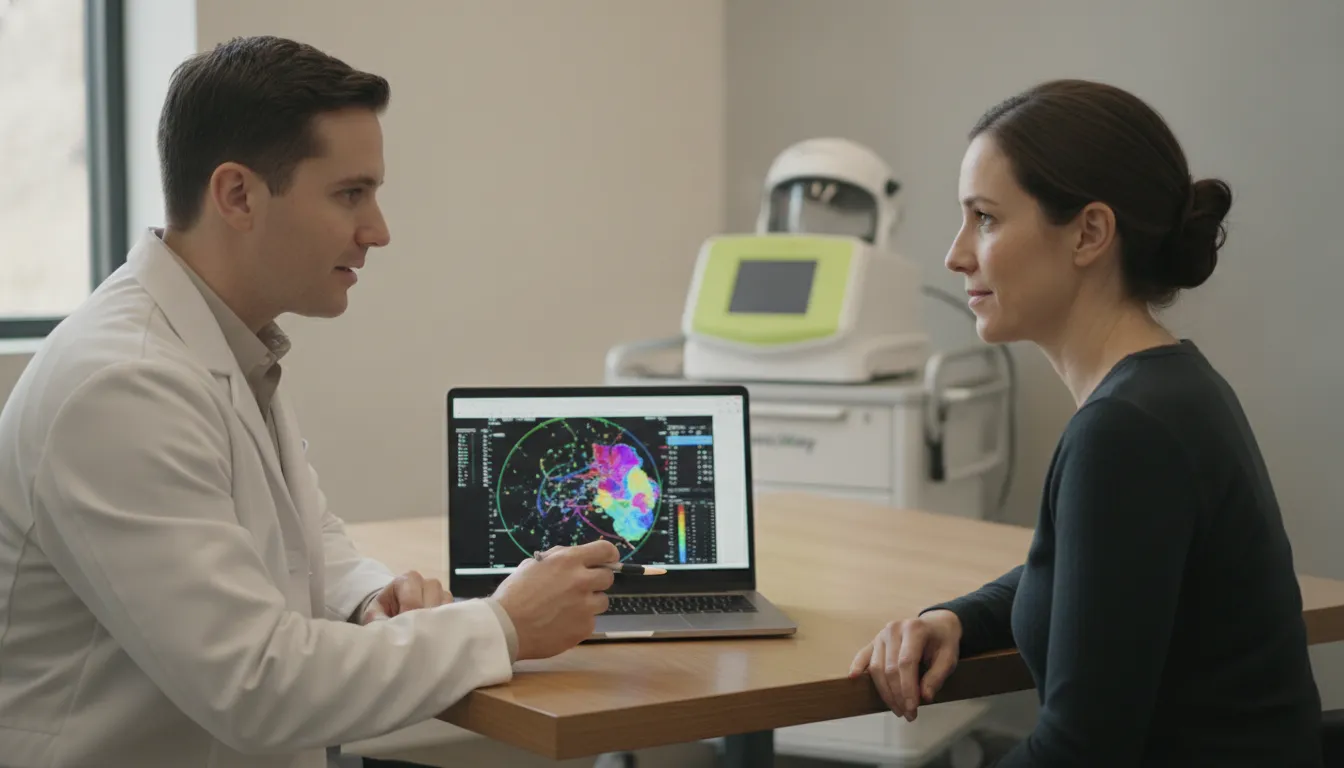
When you are considering TMS after a difficult treatment journey, it is reasonable to ask why a QEEG assessment may be recommended before treatment. QEEG brain mapping before TMS records electrical brain activity and gives the clinical team another source of information for a planning conversation.
Ready to discuss personalized TMS planning? Request a consultation today.
In brief: QEEG brain mapping before TMS is a non-invasive assessment that organizes brainwave activity into an individualized map. It may help clinicians discuss treatment strategy, but it does not diagnose a person, determine care by itself, predict a guaranteed result, or deliver TMS. Your symptoms, diagnosis, history, treatment goals, and ongoing clinical evaluation remain central.
This guide explains what the assessment is designed to do, how it can fit into a TMS evaluation. What you may experience during the appointment, and which coverage questions are worth asking. It is intended to make the process easier to understand, not to replace a conversation with a qualified clinician. For a broader explanation of TMS itself, read our TMS therapy for depression guide.
What Is QEEG Brain Mapping Before TMS?
QEEG stands for quantitative electroencephalography. During the assessment, equipment records patterns of electrical activity from the scalp while you are in a controlled, comfortable setting. Software then organizes the recording into data and visual representations that a clinician can review. The result is commonly called a brain map. Although it is better understood as a structured record of brainwave activity than as a complete picture of a person’s mental health.
The purpose of a pre-TMS QEEG assessment is to add individualized information to the treatment-planning process. A clinician may review the map for patterns that could be relevant when discussing TMS targeting or other planning questions. The assessment may also provide baseline information that can be revisited in a later clinical discussion. Its value comes from how it is interpreted in context, not from treating the map as an answer on its own.
What the assessment measures
QEEG measures electrical activity over time. The recording can show the distribution and relative organization of brainwave activity during the assessment. It does not take a photograph of the brain, and it does not directly measure every symptom, thought, emotion, medication effect, or daily challenge you experience.
That distinction matters before TMS. The map supplies one type of information, while a psychiatric evaluation supplies a much wider clinical picture. Your care team may consider both when discussing whether TMS is appropriate and how treatment decisions should be individualized. The QEEG is therefore part of an evaluation, not a substitute for one.
What it does not establish
A QEEG map does not independently establish a depression, anxiety, PTSD, OCD, or other psychiatric diagnosis. It cannot determine what a person needs without a clinical assessment. It also cannot promise that TMS will help, guarantee how quickly someone will respond, or remove the need to monitor symptoms during care.
Be cautious of any explanation that presents a brain map as a definitive label or an automatic treatment prescription. A responsible discussion should explain what the findings may contribute, what remains uncertain, and how the clinician will use other information before making a recommendation. You should have room to ask questions and consider whether the proposed evaluation fits your goals.
How Can QEEG Inform TMS Planning Without Determining Care?
TMS planning involves clinical decisions about whether treatment is reasonable, what goals should be monitored, and how the plan may be adapted over time. QEEG may add a view of electrical brain activity to those discussions. It does not make the decisions. The treating clinician interprets the results with your history, symptoms, diagnosis, medications, previous treatment experience, safety needs, and preferences.
Adding an individualized baseline
A baseline gives the team a reference point for discussing your starting picture. It may help organize information about brainwave activity before treatment begins. If the team later conducts another assessment or reviews changes in your functioning, the original recording may provide context for that conversation.
A baseline is not the same as a forecast. A later change in brain activity would not automatically prove that symptoms improved, and a stable pattern would not by itself prove that care was unsuccessful. Meaningful follow-up includes your report of symptoms, daily functioning, treatment experience, and the clinician’s assessment. These sources should be considered together.
Supporting a conversation about treatment targets
Depending on the clinical approach, QEEG findings may help a team discuss where TMS could be directed or whether certain protocol questions deserve closer attention. The map may prompt a more individualized conversation about treatment strategy rather than relying only on a general template.
That does not mean software selects a treatment target or that every finding leads to a specific adjustment. The clinician must decide what information is clinically relevant, how reliable the recording is, and how it fits with the rest of the evaluation. A patient should be told when a recommendation is based on clinical judgment, emerging research, standard practice, or a combination of these factors.
Keeping expectations realistic
Research continues to examine how EEG information may relate to TMS planning and treatment response. One PubMed-indexed study explored whether quantitative EEG could help inform strategy and response research involving right frontal TMS for OCD. That work can help explain why clinicians are interested in this area, but it does not prove that QEEG can predict an individual patient’s outcome. Review the PubMed study on QEEG and TMS research.
The practical takeaway is simple: QEEG can be a useful planning input when a clinician believes it adds value. But it is not a guarantee, a stand-alone diagnosis, or a treatment. The most useful appointment is one in which the team explains how the information will be weighed and how your progress will be evaluated beyond the map.
| Care element | Role | Limit |
|---|---|---|
| QEEG | Records brain activity | Not a diagnosis |
| Evaluation | Reviews the full picture | Not one test alone |
| TMS | Delivers magnetic stimulation | No guaranteed result |
What Happens During a QEEG Brain Mapping Session?
A QEEG appointment is structured to collect a usable recording while you remain comfortable. Many sessions take 60-90 minutes, with exact timing varying according to preparation, the recording protocol, and the clinical discussion. The team should explain the sequence before beginning and tell you how to ask for a pause or clarification.
Before the recording
The clinician or staff member may confirm why the assessment is being considered and review information that could affect the visit. Be ready to discuss your current symptoms, diagnosis history, medications, prior treatment experience, and goals. Tell the team about questions or concerns before the recording starts.
Ask whether you should follow any preparation instructions. The clinical setting may provide guidance about your normal routine, hair or scalp products, rest, or other practical details. Follow the instructions given by your care team rather than assuming that every QEEG appointment uses the same preparation.
During the recording
The team places recording equipment according to the assessment protocol. You usually remain seated and try to stay relaxed and as still as possible while the equipment records electrical activity. The assessment is non-invasive and generally painless. It does not involve an incision, and it does not deliver magnetic stimulation.
You may notice the setup or the need to keep your position steady. If you are uncomfortable, have trouble remaining still, or do not understand an instruction, tell the clinician. A clear recording is important, but comfort and communication also matter. The staff can explain what is happening instead of asking you to guess.
- Orientation: The team explains why the QEEG is being considered, reviews practical instructions, and answers questions about the visit.
- Preparation: The recording equipment is positioned according to the clinical protocol, and the clinician checks that you are ready and comfortable.
- Recording: You remain seated while the equipment collects electrical activity. You follow the team’s instructions and report discomfort or uncertainty.
- Data review: The recording is organized for clinical interpretation. The map is considered with your symptoms, history, diagnosis, goals, and broader evaluation.
- Next-step discussion: The team explains what the findings may contribute to TMS planning and identifies appropriate next steps without treating the map as an automatic decision.
After the recording
You may not receive a complete interpretation immediately. The clinician may need time to review the recording and consider it alongside your evaluation. Ask when you can expect a discussion of the results and who will answer follow-up questions.
The next conversation should connect the assessment to your care goals. If TMS is being considered, ask how the findings may influence planning, which decisions are based on other clinical information, and how the team will monitor your response. You should also understand what happens if the map is unclear, does not add useful information, or does not support the initial planning idea.
How Are QEEG Results Interpreted With a Psychiatric Evaluation?
Interpretation begins with context. Brainwave patterns do not have a single meaning separated from the person who produced the recording. The clinician may consider the quality of the recording, the circumstances of the appointment. Your symptoms, your diagnosis, your treatment history, current medications, medical history, and the goals you identified.
This is why a QEEG should not be marketed as a shortcut around a psychiatric evaluation. The clinical interview addresses questions that a recording cannot answer by itself. It helps the clinician understand how symptoms affect your life, what treatments you have tried, what matters to you, and what risks or practical factors should be considered.
Questions the map cannot answer alone
A QEEG cannot determine whether a particular diagnosis applies, explain every reason a symptom is present, or identify the best treatment without clinical judgment. It cannot replace a discussion of medications, therapy experience, medical history, sleep, substance use, safety, or day-to-day functioning. It also cannot tell you with certainty how you will feel after TMS.
These boundaries are not a weakness in your care. They are a reason to use the assessment responsibly. The map can contribute information while the clinician keeps the focus on your experience and the full evaluation. You should be able to ask which findings are meaningful, which are uncertain, and how the team avoids over-interpreting them.
How progress should be followed
Progress should be discussed using more than a QEEG result. Your care team may review changes in symptoms, functioning, comfort, goals, and other clinical observations. If the treatment plan needs to change, the reason should be explained in language you can understand.
A personalized approach is not a promise that every decision will be predictable. It means the team uses available information, listens to your response, and keeps the plan responsive. QEEG may be part of that process, but your ongoing clinical assessment remains essential.
Is QEEG Covered by Insurance Before TMS?
Coverage for QEEG before TMS varies. A plan may review the assessment and the treatment under different benefit categories. And the outcome can depend on the service description, documentation, network status, and the details of your plan. A general statement about QEEG or TMS cannot confirm what your plan will cover.
Separate coverage questions from care decisions
Insurance information and clinical recommendations answer different questions. The clinical team determines whether an assessment or treatment may fit your situation. Your insurer explains how it handles benefits and claims. Neither a map nor a coverage statement can replace the other conversation.
Ask the care team what service is being considered, why it is part of the evaluation, and what documentation may be needed for a coverage discussion. Ask your insurer how it reviews the specific service and whether you need to confirm network or authorization details. Coverage information can change, so verify current details before scheduling or beginning care.
Questions to ask about the appointment
- Is QEEG included in the proposed evaluation, or is it a separate service?
- How will the assessment be described when the coverage question is reviewed?
- What information should I provide about my diagnosis, treatment history, and plan?
- Who can explain the next step if my insurer needs more documentation?
- What should I confirm with my insurer before the appointment?
Ask for clear explanations rather than relying on assumptions. The team can help you understand the process and the questions to raise, while your insurer remains the source for plan-specific coverage information. No coverage discussion should be presented as a guarantee of payment.
What Should You Ask Before QEEG Brain Mapping Before TMS?
A good consultation gives you enough information to make an informed decision about the evaluation. You do not need to understand every technical term before you arrive. You do need an opportunity to understand the assessment’s purpose, limits, timing, and place in your care plan.
Ask how the assessment will be used
- What question is the QEEG intended to help the team explore before TMS?
- Which treatment-planning decisions might the results inform?
- Which decisions will still depend on my clinical evaluation and treatment response?
- How will you explain findings that are uncertain or not useful for planning?
Ask what the visit will involve
- How long should I plan to be at the appointment?
- What preparation instructions should I follow?
- What will I feel during the recording, and how should I report discomfort?
- When and with whom will I review the results?
Ask how progress will be monitored
- How will you measure changes in symptoms and daily functioning?
- How will my feedback influence the plan?
- What happens if the QEEG does not provide a clear planning signal?
- How can I raise a concern or request clarification during treatment?
These questions keep the conversation practical and patient-centered. They also help you distinguish a careful explanation from an overly broad promise. A clinician should be willing to describe both the potential value and the limitations of QEEG brain mapping before TMS.
How Relief Mental Health Approaches Personalized TMS Planning
Relief Mental Health views TMS planning as an individualized clinical process. The care team considers your diagnosis, symptoms, history, treatment goals, and overall evaluation before discussing whether TMS may fit your needs. When QEEG is included, it adds information about electrical brain activity to that conversation.
The aim is not to reduce your care to a map. It is to combine technology with clinical expertise, careful listening, and ongoing follow-up. The team can explain what the assessment may contribute, what remains uncertain, and how your experience will guide the next steps. To learn more about the treatment approach, visit the TMS therapy for depression resource.
Schedule a consultation to discuss QEEG and personalized TMS planning.
Frequently Asked Questions
Is QEEG brain mapping before TMS painful?
QEEG is non-invasive and generally painless. The team places recording equipment according to the protocol, and you remain seated while electrical activity is recorded. You may notice the setup or the need to remain still, but the assessment does not deliver magnetic stimulation. Tell the clinician if you are uncomfortable or need an instruction repeated.
How long does a QEEG brain mapping before TMS appointment take?
Plan for 60-90 minutes, with exact timing varying according to preparation, the recording protocol, and the clinical discussion. Ask the team what your appointment includes and when results will be reviewed. The recording itself may be only one part of the visit.
Does QEEG determine whether I should receive TMS?
No. QEEG can provide information that may support a planning conversation, but it does not determine care by itself. The clinician considers the map with your symptoms, diagnosis, history, goals, and broader evaluation. The team should explain how each source of information contributes to the recommendation.
Can QEEG predict my individual TMS outcome?
QEEG research may help clinicians study patterns related to treatment planning and response, but a map cannot guarantee an individual result. Your experience should be followed through ongoing clinical assessment, symptom discussion, and monitoring of your goals. Ask how the team will evaluate progress beyond the QEEG findings.
What should I ask about insurance coverage?
Ask whether QEEG is part of the proposed evaluation, how the service will be described. What documentation may be needed, and who can help you prepare questions for your insurer. Coverage varies by plan and situation, so confirm current details with both the care team and your insurance provider. Avoid treating a general coverage statement as a payment guarantee.
Take the Next Step With a Clearer TMS Plan
Understanding QEEG brain mapping before TMS can help you approach the assessment with realistic expectations. The recording may add useful information to treatment planning, while your diagnosis, symptoms, history, goals, and ongoing clinical evaluation remain essential. A consultation is the right place to discuss whether this assessment and a personalized TMS evaluation fit your situation.