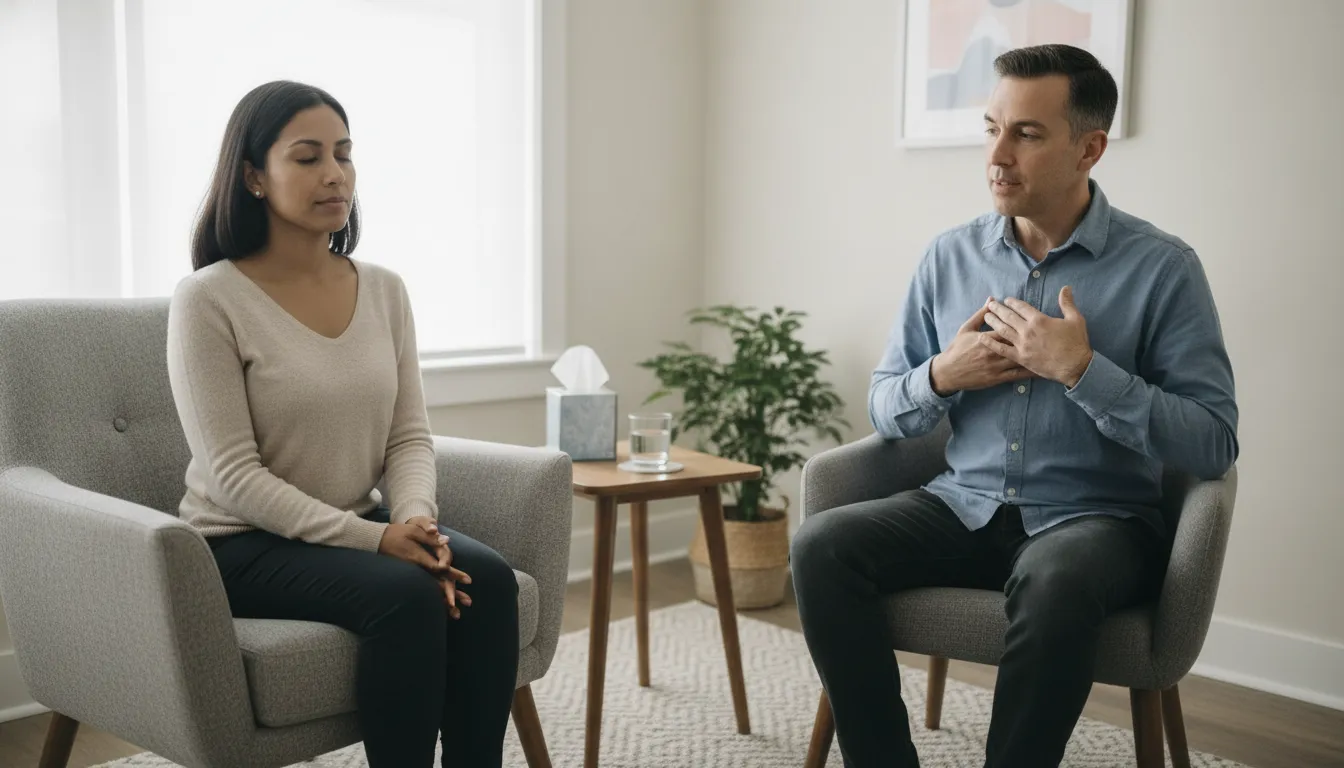
Deep breathing for anxiety can be a simple way to pause and settle your attention when worry or tension rises. Slowing the breath may help some people feel calmer in the moment, but it does not work the same way for everyone and does not replace an evaluation or ongoing care when anxiety is affecting daily life.
How can breathing affect anxiety?
Anxiety can bring a range of physical and emotional experiences. A person may notice a faster heartbeat, tight muscles, shallow or rapid breathing, restlessness, or difficulty keeping attention on the present. These reactions can make the moment feel more intense. Paying attention to the breath offers a concrete, repeatable point of focus.
Breathing slowly and comfortably may support the body’s relaxation response. A review of breathing practices describes possible links between paced breathing, changes in nervous-system activity, and lower stress or anxiety. The findings support breathing as one possible coping practice, not as a guaranteed way to stop anxiety. Read the review of breathing practices for stress and anxiety.
Some people find that an even, unforced breath helps them feel more grounded. Others may not notice much change, or may feel more aware of uncomfortable sensations when they focus inward. Both responses are possible. You do not have to breathe deeply or follow a strict count for the practice to be useful.
Try thinking of the goal as making a little room to respond, rather than forcing anxiety to disappear. A breathing exercise can be one part of a larger coping plan. It cannot explain why anxiety is happening, determine whether someone has an anxiety diagnosis, or provide the individualized support a clinician can offer.
Which breathing technique can you try?
Start in a position that feels steady and comfortable. You can sit, stand, or lie down. Let your shoulders rest. Keep your eyes open or closed, whichever feels better. Breathe at an easy pace; do not strain to fill your lungs or hold your breath.
Gentle, longer exhale
- Notice your breathing without changing it for a few cycles.
- Breathe in gently through your nose if that is comfortable.
- Let the breath out slowly, making the exhale just a little longer than the inhale.
- Repeat for several cycles, then return to your usual breathing.
There is no required count. If counting is calming, you might breathe in for a count of three and out for a count of four. If counting makes you tense, leave it out. The breath should stay comfortable. A small, gradual change is often easier to maintain than a very deep inhale or a long breath hold.
Steady, even breathing
If a longer exhale does not feel comfortable, try making the inhale and exhale about the same length. Breathe gently in and out at a pace that feels natural. Rest your attention on the sensation of air moving, or on the rise and fall of your abdomen. When your mind wanders, notice that and return to the next breath without judging yourself.
Breathing with a simple point of focus
Some people find it easier to pair breathing with an external focus. For example, look at an object in the room and name a few details silently: its shape, color, and position. Let your breathing remain natural while you do this. This can be a useful alternative if watching each breath increases unease.
A small study reported that practicing cyclic sighing for five minutes a day was associated with improved mood and reduced anxiety for participants. The study explored a particular structured technique, so its findings should not be taken as proof that one exercise will work for everyone. You can read the Stanford Medicine report on cyclic sighing for more context.
How do the approaches differ?
There is no single best exercise for everyone. Use this comparison to choose a gentle starting point, then adjust based on how you feel. The steps are suggestions, not a test to pass.
| Approach | What to do | May suit you when | What to keep in mind |
|---|---|---|---|
| Gentle, longer exhale | Let each comfortable exhale last slightly longer than the inhale. | You want a simple rhythm to follow. | Do not force a long exhale or hold your breath. |
| Steady, even breathing | Keep the in-breath and out-breath at a comfortable, similar pace. | Uneven counts or extended exhales feel uncomfortable. | Use a natural pace rather than trying to breathe as slowly as possible. |
| Breath plus visual focus | Keep breathing naturally while noticing a few details in the room. | Focusing directly on breathing makes you feel more tense. | The breath does not need to change for this grounding option to help. |
| Pause and return to normal breathing | Stop the exercise, relax your posture, and let your breath find its usual pace. | You feel dizzy, strained, or more uncomfortable. | There is no need to push through discomfort. |
What should you know before trying it?
“Deep breathing” is often used to mean slow, deliberate breathing, but taking very large or repeated breaths can feel uncomfortable. Breathing too quickly or deeply may contribute to lightheadedness, tingling, or a feeling of being unsettled. If this happens, stop counting and let your breath return to its normal rhythm. Sit down if you feel unsteady. Do not restart unless you feel comfortable doing so.
It is also fine to keep your eyes open, breathe through your mouth if needed, or choose a different grounding activity. If focusing on your breathing brings up distress, shift your attention outward: notice the floor beneath your feet, identify objects around you, or describe what you see. These are options, not requirements.
Try a brief practice at a neutral time before relying on it during a stressful moment. A few comfortable cycles may be enough to learn whether it suits you. If you prefer more structure, you can use a timer, but stop when the exercise begins to feel forced. Do not use breathing practice in place of medical advice for new, severe, or concerning physical symptoms.
Breathing exercises are coping tools, not a measure of how hard someone is trying. If anxiety remains, that does not mean you did it incorrectly. Anxiety can have many influences, and a short exercise may offer only a temporary shift in attention or body tension. Some moments may feel easier; others may not change.
How can you use a breathing exercise in daily life?
It can help to decide in advance when you might try a few steady breaths. The aim is not to monitor every breath throughout the day. Instead, attach the practice to a moment when a short pause would be useful. For instance, before opening a difficult email, you might put both feet on the floor, notice the chair beneath you, and take a few comfortable breaths before reading. If you are waiting for an appointment, you could soften your shoulders and follow one natural inhale and exhale at a time.
Keep the plan modest enough to remember. A cue can be something you already do, such as sitting down at your desk, getting into your car while parked, or preparing to begin a conversation. Choose a safe moment when you can give the exercise attention. Do not use a breathing routine while driving or doing another task that requires full attention.
It may also be useful to decide what you will do if breathing does not help. You could shift to noticing colors and shapes nearby, feel your feet against the floor, take a short break if possible, or reach out to someone you trust. Having an alternative prevents the exercise from becoming a test you feel you must pass. A coping tool is useful only when it is workable for you in that moment.
How can you tell whether the exercise suits you?
After a short practice, check in without grading yourself. Ask: Did I feel more settled, about the same, or more uncomfortable? Was the pace easy to maintain? Did focusing inward help, or was it easier to notice something around me? A simple observation can help you choose whether to repeat the same approach, make it gentler, or use another grounding tool next time.
You can also note the situation in which you tried it. For example, write down that a longer exhale felt comfortable before a meeting but felt awkward when you were already lightheaded. That kind of detail is more useful than labeling a technique as a success or failure. It can help you explain your experience to a clinician if anxiety is repeatedly affecting your routine.
Do not use a particular number of breaths, a timer, or a sense of calm as a measure of progress. Your response can vary with the moment, the setting, and how you feel physically. If the practice increases distress, that is enough reason to stop. You can choose another approach without needing to prove that the breathing method works for you.
When might professional support be helpful?
Consider talking with a qualified mental health professional when anxiety is persistent, hard to manage, or interfering with sleep, work, relationships, or everyday activities. A clinician can listen to what you have noticed, discuss whether an evaluation is appropriate, and help identify care options that fit your needs. Breathing may still have a place in a plan, but it need not carry the full burden of managing anxiety.
Support can be useful even if you are unsure whether what you are experiencing meets criteria for an anxiety diagnosis. You can begin by describing what is happening, when it tends to arise, and what you have already tried. Relief Mental Health offers psychiatry and medication management and therapy services. A care team can discuss whether an evaluation or a particular form of support may be appropriate for you.
Anxiety may also occur alongside depression or other diagnoses. For information about the care options Relief describes for these concerns, see its pages on depression treatment and OCD treatment. These pages provide service information; only a qualified clinician can assess an individual and discuss their care.
How can you make breathing practice part of a broader plan?
A practical plan can be simple. Choose one technique that feels comfortable, decide when you might use it, and keep an alternative in mind. For example, you could try a few gentle breaths before a difficult conversation. If that does not feel helpful, shift your attention to the room or contact someone you trust.
- Keep expectations realistic. The goal may be to pause, feel a little steadier, or return attention to what you are doing. You do not need to feel completely calm for a practice to have served a purpose.
- Make it accessible. You can try a comfortable posture and a few breaths without special equipment or a quiet setting.
- Notice your response. If you feel more tense, dizzy, or uncomfortable, stop and return to ordinary breathing.
- Look at the larger pattern. If anxiety repeatedly disrupts daily life, note what you experience and bring it to a clinician rather than relying on a single coping skill.
- Be flexible. A grounding exercise, a conversation with someone you trust, or professional support may fit better at a given moment.
For general information on breathing approaches, Ohio State’s health resource explains how slow, steady breathing may support a calming response. Its overview of breathing exercises and anxiety offers another perspective. As with any general resource, it cannot determine what is right for you personally.
Relief Mental Health provides outpatient behavioral health services, including psychiatry and therapy. If anxiety is interfering with your routine, you can review the treatments offered by Relief Mental Health and discuss possible next steps with its team.
Request a consultation to discuss support
Frequently asked questions
How long should I practice deep breathing?
There is no set duration that suits everyone. Start with a few comfortable breaths and stop if you feel strained or uneasy. You can use a short practice when you want to pause, rather than treating a fixed number of minutes as necessary.
Can breathing stop an anxiety episode?
It may help some people feel more settled or focused, but it cannot be relied on to stop anxiety. If breathing practice does not help, that is not a personal failure. Try an outward-focused grounding activity or seek support if anxiety is recurring or affecting daily life.
What if paying attention to my breath makes me feel worse?
Stop the exercise and let your breathing return to its usual pattern. You can focus on a steady object, name what you see around you, or notice your feet on the floor instead. If this reaction happens often, mention it to a qualified clinician.
Is deep breathing a substitute for therapy or an evaluation?
No. It is a self-guided coping practice. A clinician can discuss your experience, assess whether an evaluation is appropriate, and explain support options. Breathing may be one tool alongside care, but it does not provide an assessment or individualized treatment.
What is the main takeaway?
Deep breathing for anxiety may offer a simple pause and help some people feel steadier, especially when the breath stays gentle and comfortable. It is also normal for it to have little effect or to feel uncomfortable. Stop if it does not suit you, and consider professional support when anxiety is persistent or getting in the way of daily life.